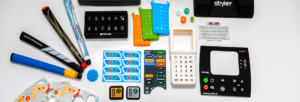


Silicone rubber is the ideal option when designing components with irregular shapes, sizes and thicknesses, and offers many advantages over other elastomers. When designing and planning production, the most important factor to consider is mold design and characteristics. There are many options to consider, including location of gate, parting lines and tracks, as well as the metal used to make the mold. All these factors will contribute to the successful production of silicone rubber molding components.
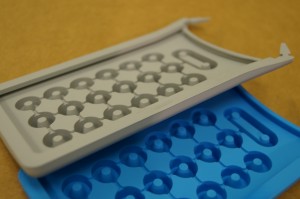 When designing undercuts and other complicated shapes into your product, special attention and knowledge of liquid silicone injection molding must be used to produce a mold that will work successfully for the life of your product. Undercuts are a recessed cavity that allows your product to be secured to another component or printed circuit board without additional fasteners or adhesives. Undercut molding can prove to be more difficult to produce than traditional parts, thus a level of knowledge and skill in the design can help to eliminate molding issues. At SiTECH, our engineers consider all aspects of silicone rubber and liquid silicone rubber (LSR) molding to predict how silicone will flow and react when injected into a hot mold.
Silicone rubber has a very low viscosity and flows into a hot mold easily, even at low pressures. The gate location is important and is determined by the thickness of the part, as well as the quantity of parts being produced in each cycle. The parting line, where the two halves of the mold meet, and the tracks location and depth are also important to ensure proper fill before the silicone begins to cure. LSR molding shrinks at a predictable rate once cooled and must be taken into account when planning the dimensions of the mold.
The metal used in creating a mold is another option to consider. Steel core molds are the long trusted and durable choice when considering mold materials. Steel molds hold heat very well and are extremely durable, even after repeated heating and cooling cycles, for the life of your product. Aluminum molds are another option; they are lightweight, heat quickly and are less expensive. Silicone rubber takes on the characteristics of the mold’s finish, so texturing a mold can provide a clean matte finish, while polishing a mold can provide a clear unblemished component or insert for molding into another part.
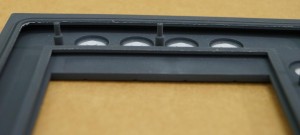 At SiTECH, we specialize in all aspects of silicone rubber production. From the mold design and implementation, we can help with all questions and concerns. We work with the most experienced silicone mold makers in the industry to provide only the best molds to last the life of your product. We also offer rapid prototyping to bring your designs to fruition while working on your production needs. For all your silicone rubber molding needs, SiTECH has the expertise you can trust.